
Eastern Orthodoxy Under Fire: Responding to Michael W. Davis

Michael Davis’s article Vatican 1 Debunks Itself: A Response to Erick Ybarra has a basic claim: the Council of Vatican 1’s decree on the papacy is false because the papacy that it promises doesn’t exist and has never existed. In other words, Pastor Aeternus (the decree on the primacy of the Pope issued at Vatican I) claims that the Papacy is meant to be this perfect, ever-present, always-abiding, and never-failing help to all Christians by always providing the truth and support of the Apostolic faith. If it fails to do this, then Pastor Aeternus is wrong. As a result of this, Davis observes that when he was converting to Eastern Orthodoxy, it was abundantly obvious that the Papacy is false. And thus, the case for Orthodoxy is obvious because of how clear the papacy fails to be what it promises.
That is a fairly straightforward summary of the article. Below, I give my response to his claims. Here is the table of contents:
Does the Eastern Orthodox Episcopate Live Up to Its Claims of Infallibility?
Quote Mines or Byzantine Florilegia?
Knowing Vatican 1 is False is Obvious
Obscure Historical Events?
Where’s the List of Ex Cathedra Decrees?!
The Papacy Fails in Practice
Papal Infallibility Fails the Universality Test
Matthew 16 Does Not Refer to the Papacy
Empty Honorifics
What Catholics Have to Prove to Defend Vatican 1
Emperors Called the Ecumenical Councils
The Meletian Schism
4 Marks of the Church Do Not Include a 5th → “Papal”
The Fathers Granted Privileges to the Throne of Old Rome because it was the Royal City
The Council of Constantinople (553) Rejects the Papacy
Anathema to Honorius, Pope of Old Rome!
No One Can Add to the Creed!
CONCLUSION
Please forgive the length, but as a man who fixes machines all day, “It takes what it takes.” Unfortunately, sometimes errors can be quickly stated, but since many errors could be a tangle of misunderstanding, errors, and misconceptions, it requires extra time to untangle the knot before one can proceed to make a positive response. One might complain about the length of this article, and the same will have my sympathies. This is written for those who are devoting the time to be educated. Lastly, the thumbnail is just for fun :)
(1) Does the Eastern Orthodox Episcopate Live Up to Its Claims of Infallibility?
Behind Davis’s “debunking” of Vatican 1 appears to me to be the idea that the Orthodox Church’s system of ecclesiology is more capable of bearing with the errors, heresies, schisms, and complications in the Church than the Catholic Church’s. You hear this quite a bit from the “OrthoBro” community: “We don’t put our eggs in one basket!” The idea here is that because there is no centralization of authority in one Patriarch, the Orthodox Church can have heretical Patriarchs and Bishops, and this tragedy wouldn’t create a system failure for its ecclesiology because there is neither a guarantee of individual-Patriarchal or even corporate-Episcopal infallibility. Better yet, the Orthodox Church, in this acclaimed schema, doesn’t even have a partial-corporate-Patriarchal infallibility. So the Orthodox Church, it is claimed, can endure quite a bit of damage with having Patriarchs who openly depart from the Orthodox faith and the canonical tradition, since there are no built-in guarantees of infallibility, while in Catholicism, the Papacy is claimed to be a fixed principle of infallible protection from which the guarantee of flawless protection, if true, should unmistakably yield that result.
Only, this isn’t Eastern Orthodox ecclesiology, and that’s why I began the previous paragraph saying that it would “appear” that behind Davis’s critique of the Papacy is as stated. Davis, however, should know, if he doesn’t already, that this isn’t really true to Eastern Orthodoxy, and the sources demonstrate that quite clearly.
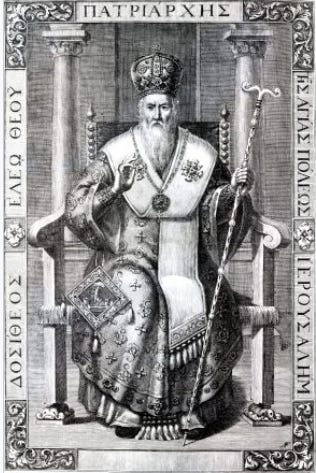
In the 10th decree of the Confession of Dositheos (ratified by the Patriarchs in conjunction with the Council of Jerusalem 1672), we read that the Orthodox Church, too, believes that Christ, the Head of the Church, governs His Church through the instrumentality of an ordained leadership (i.e., “Holy Fathers”):
Since a mortal man cannot universally and perpetually be head of this Catholic Church, our Lord Jesus Christ Himself is head, and Himself holding the rudder is at the helm in the governing of the Church through the Holy Fathers. And, therefore, the Holy Spirit has appointed Bishops as leaders and shepherds over particular Churches, that are real Churches, and consist of real members [of the Catholic Church]. These authorities and heads [were not appointed] by abuse, but properly, and look unto the Author and Finisher of our Salvation, {cf. Hebrews 2:10; 12:2} and refer to Him what they do in their capacity of heads.
In Orthodox ecclesiology, the episcopal leadership is the visible organ through which Jesus Christ governs, sanctifies, and teaches all members of His body (i.e., the baptized faithful). The episcopate is not just a transitory tool, but rather is co-operative with Christ Himself, who promised to abide and guide His Church on earth through the bishops. That is, the Episcopate was built into the architecture of the Church so that it would be free from error on earth:
For since the Lord has promised to be with us always, although He is with us by other means of grace and Divine operations, yet in a more eminent manner does He make us His own and dwell with us through the Bishop as chief functionary and through the divine Mysteries [sacraments] is united with us. The Bishop is the first minister, and chief functionary, through the Holy Spirit, and does not allow us to fall into heresy. And, therefore [John] of Damascus, in his Fourth Epistle to the Africans, said that the Catholic Church is everywhere committed to the care of the Bishops.
In the 12th decree of the same confession, we begin to get more unpacked about this claim to episcopal infallibility:
We believe that the Catholic Church is taught by the Holy Spirit. For he is the true Paraclete; whom Christ sends from the Father, {cf. John 25:26} to teach the truth, {cf. John 26:13} and to drive away darkness from the minds of the Faithful. The teaching of the Holy Spirit, however, does not directly illuminate the Church, but [does so] through the holy Fathers and Leaders of the Catholic Church. All Scripture is, and is called, the word of the Holy Spirit, not that it was spoken directly by Him, but that it was spoken by Him through the Apostles and Prophets. In like manner the Church is taught indeed by the Life-giving Spirit, but through the medium of the holy Fathers and Doctors (whose rule is acknowledged to be the Holy and Ecumenical Synods; for we shall not cease to say this ten thousand times); and, therefore, not only are we persuaded, but do profess as true and undoubtedly certain, that it is impossible for the Catholic Church to err, or at all be deceived, or ever to choose falsehood instead of truth. For the All-holy Spirit continually operating through the holy Fathers and Leaders faithfully ministering, delivers the Church from error of every kind.
This is a bold claim to ecclesiastical infallibility, that the Church, being led by the Holy Spirit in the person of its leaders (i.e., the Bishops), teaches the faith, drives away darkness from the minds of the faithful, makes it impossible to err, and illuminates the whole Church with the truth of Christ. This article of Dositheus’s confession is cited in The Longer Catechism of St. Philaret of Moscow (#271). And although it is mentioned that the Ecumenical Councils are the “rule” of the Episcopate, it is not as if the decree claims that it is only in Ecumenical Councils that the Holy Spirit delivers the Church from error.
And so, with this bold claim to the infallibility of the Orthodox Church, namely, that the Holy Spirit will be an ever-present, always-abiding, and permanent help to the Church through the medium of the Episcopate, how does Davis reconcile this with Church History? How does he reconcile this with current-day crises in the Orthodox Church? If Davis isn’t aware, I’d be happy to run through the many “inconsistencies” and “contradictions” that are currently in the open with the communion of the Eastern Orthodox churches. But here the point is that both informed Catholics and Orthodox are aware that, at times, significant portions of the Church, in the person of its bishops, turned aside to heresy and led many souls to hell. Davis might say that these precious promises of Christ are not invalidated by the presence of erring bishops and significant portions of the Church failing, even for significant durations of time.
And Davis would certainly be right to say so! Christ promised that He Himself would be the builder of His Church and that she, being founded upon the firm rock of St. Peter’s confession, would never be prevailed against by the gates of hell. And yet, the Church has had major battles against the gates of hell for centuries. As it turns out, having to experience what might appear to be “suspensions” from that promise of divine protection does not invalidate the promise of Christ. In His wisdom, God allows for human sin, failure, evil, and falsehood to run a certain course even within, and perhaps purposefully within, the realm of His covenant people. In other words, even though the Orthodox Church teaches that the Episcopal government of the Church was built by Jesus Christ Himself for the protection against error, an Orthodox Christian will also admit that the realization of that promise doesn’t come in the form of a perfect Episcopate everywhere at all times, but only on certain conditions that are to be known by certain manifest criteria.
What, then, does an Orthodox Christian forbid from a Catholic in defending the papacy against the charge that the papacy isn’t what it claims to be because of fallible expressions in history (and in the current day) when the Orthodox Christian himself affords to his own system the benefit of not being a perfect, error-free Episcopate while still upholding the ecclesiological doctrine that the Episcopate is the infallible protector against error for the Church on earth?
Surely, the Confession of Dositheos sells a very promising gift from the reigning Christ, does it not? The Episcopate was established and built by the risen Christ to provide infallible protection against error for the Church on earth. And yet, the Orthodox Church, along with the Catholic Church, admits of certain crises, suspensions, doctrinal warfare, and even open contradictions until a time when Christ, in His own determination, intervenes to supply the graces needed to overcome these obstacles to doctrinal clarity.
Why, then, is it the case that when Vatican 1 speaks about the same promises from Christ in relation to both the Episcopate and the Papacy, Davis sees a false advertisement in light of God’s providence allowing error and division to run their course even within the Catholic Church?
Well, it is because he thinks the Catholic Church is promising a more perfect guarantee based upon the prerogatives of the Papacy to squelch heresy and schism. But he would be missing the point here if he didn’t grasp that the Orthodox Church teaches precisely the same concerning the Episcopate without a Papacy, and that even with the absence of a single Patriarch with rights and promises akin to the Roman Pontiff, the very same goal is had: protection against doctrinal error and schism.
In Catholicism, there is a major avoidance of schism in light of the jurisdictional communion of the Pope, and doctrinal errors can be argued to have been avoided in official or magisterial texts. There are many problems in the current-day Catholic Church, but much of it stems from a lack of discipline rather than from the Church’s own treasury of doctrine and morals. Bad clergy, ranging anywhere from a deacon to the Pope, can cause scandals, but that does not impugn the divine origin of the Church, nor its permanent institution. The general point that I wish to make here is that the conceptual promises of infallibility, extending to both Catholic and Orthodox ecclesiologies, are not invalidated or rendered incredible when the Church on earth undergoes times of distress where an intervention of the Lord Himself is sought. Davis does not have the benefit of appealing to an ecclesiology of his own that permits heresy and schism with no problem and more consistently than Catholics (i.e., free of a systemic problem).
Au contraire! Classical Orthodox ecclesiology says the visible Church is immune from this. And yet, we see open and manifestly “apparent’ contradictions going on in contemporary Eastern Orthodoxy without the due anathemas. And whatever exceptional circumstances exist where heresy or schism attack the Church, the very same explanations that the Orthodox offer to maintain their own ecclesiological consistencies are sufficient to accomplish the same goal for Catholicism.
“We don’t put all our eggs in one basket!”
Sure, the Orthodox Church doesn’t teach that there is a single Patriarch who is infallible. Nonetheless, the Orthodox Church believes that the true Episcopate is protected from error and cannot mix in communion with heretics. As soon as public communion is held with heretics, it taints the Episcopal purity by blending good and evil beliefs and works as if they were both good. How can it be otherwise?
(2) Quote Mines or Byzantine Florilegia?
Davis writes:
When I converted from Catholicism to Orthodoxy, my biggest obstacle was how obvious the case for Orthodoxy seemed. The arguments for papal infallibility and supremacy as defined by the First Vatican Council (“papalism” hereafter) struck me as weak—so weak that I assumed I must have missed the “real” defense. Yet the more research I did, the less plausible its claims appeared. This experience has shaped my approach to apologetics. For instance, Catholics like Erick Ybarra defend their position with quote mines and references to obscure historical events. Many Orthodox apologists respond to Mr. Ybarra by getting into the weeds with him. I believe this is a mistake. With all due respect to our Catholic friends, it gives their position too much credit.
In recent years, there has been growing irritation among the Orthodox at “papal quote mines,” i.e., lists of quotations that portray the belief in papal supremacy. No one likes to see a bunch of quotations that are ripped out of context and do not accurately represent the intended purpose of the one quoting them. However, this general irritation of “quote mines” might prove to be selective. Here’s why. The method of gathering a bunch of quotes to illustrate a pattern, a teaching, or a message was widely used in Greco-Roman antiquity. This method was a chief method in the Byzantine theological school to prove a certain doctrine. The Latin flos (flower) and legere (to gather), which together make florilegium (gathering of flowers). For further history on this, see the article by Alexander Alexakis, Professor of Byzantine Philology at the University of Ioannina, Greece, entitled “Byzantine Florilegia,” The Wiley Blackwell Companion to Patristics, ed. Ken Parry (West Sussex, UK: Wiley Blackwell, 2015), 15-49.
Would Davis fault St. Maximus the Confessor for the work he put into gathering quotations from the Fathers in a lengthy florilegium used to prove the antiquity of dyotheletism (two wills in Christ) and anathematize the monothelites at the Roman synod (649)? During the Council of Constantinople (681), the bulk of the theological debate was a comparison between the florilegia of Macarius of Antioch and Pope St. Agatho. Agatho utilized the very same method and provided a Latin/Greek catenae (catena= chain), another word matching florilegium, of dyothelite quotations from the Fathers. Would Davis fault the Byzantines for doing this very thing at the 7th Ecumenical Council on the antiquity of image veneration?
Anyone who has respect and admiration for the Byzantine theological school cannot, in principle, grow irritated with one of its chief methods of proving doctrine. And so while many today might decry the “papal quote mines,” all this comes across as decrying the Christological or iconodule florilegia that were used by the Ecumenical Councils! Let’s call them papal florilegia and restore respect to our mutual Latin and Greek schools of theology. The problem is not the method of stitching quotations together. Rather, the problem is with the viewer who thinks that the florilegium is meant to stop the investigation. Rather, it is meant to invite the student to dig further and vindicate or expose the compiler of having been true to the authors he has drawn from in his compilation.
Catholics like Erick Ybarra defend their position with quote mines and references to obscure historical events
I’m not sure if Michael Davis has, with respect to the subject of the Papacy, ever listened to my presentations, read any articles I’ve written, or read a single page of my book The Papacy: Revisiting the Debate Between Catholics and Orthodox. But if anyone were to ask how I “like” to “defend” the Papacy, one just has to review all of the attributes of my work, even on the surface, and they will quickly see how Davis is poorly representing the facts.

I’ll just mention that in my book, I don’t quote anything from the 1st millennium on the Papal primacy until the 8th chapter (p. 127)!!
Let’s review the content of the first 100 pages, shall we?
The first chapter, Historical Sources, is devoted to collecting the proper historical source material in which Catholics and Orthodox must conduct the investigation for their debate on the primacy. The second chapter, Historical Methodology, is a crash course on the methods of studying history and its texts, as well as the hermeneutics that are involved in the study of the Fathers and Church history in general (i.e., what counts as evidence, philosophy on probability, etc., etc.). In this, I spent over 20 pages looking at what Orthodox scholars have said, so that I never misrepresented their own methods. The third chapter, Epistemological Considerations, enters into the domain of epistemology and how we understand not just the study of historical texts but the certain theological presuppositions that Catholics and Orthodox bring to the study of Patristic literature and the Dogmatic texts of the past, wherein both of our Churches claim heritage. I did my due diligence in studying the phronema of the Orthodox in their own paradigm, either from sobornost-ecclesiology or even from the so-called “Latin Captivity” representatives, citing from Fr. Dumitru Staniloae, Philip Sherrard, Fr. John Meyendorff, Aleksei Stepanovich Khomyakov, the late Archbishop Stylianos Harkianakis (contra Khomyakov), and others. In the fourth chapter, Primacy in the Orthodox Church, I dive deep into the authoritative texts of the Orthodox tradition, citing countless Orthodox theologians. The fifth chapter, Primacy in the Catholic Church, is a crash course on primacy in the Catholic Church. I wrote both of these chapters so that the reader could know what to compare and contrast as we entered into the study of history. The sixth chapter, The Development of Doctrine, is a study of how both Catholics and Orthodox understand theological development. The seventh chapter, The Papacy in Holy Scripture, is an investigation of the biblical texts alongside several commentaries from non-Catholic exegetes, including Eastern Orthodox.
As for when the book plunges into the study of the 1st millennium, history, one could hardly have read it and come out with the idea that it is merely “references to obscure historical events.” Every single chapter, section, and excursus was devoted to a monumental pillar of Church history that both Catholics and Orthodox historians and theologians have continued to visit and revisit even unto this day! In my footnotes, I maintained a likely 80/20 ratio of non-Catholic to Catholic scholarship. I begin with the pre-Nicene era and work through to the Photian councils and the climactic tragedy of 1054 in the city of Constantinople. Following this, I have a 70-page comprehensive historical analysis, a concluding reflection, and an Appendix on the Donation of Constantine and the False Decretals. Is there any chapter that Davis can point to that would qualify as an obscure historical event? Moreover, I have countless footnotes to Orthodox and Protestant scholars who have researched the material at the professional level.

If one were to have watched my debate with Ubi Petrus, my arguments rested, not upon obscure history, but rather on the concrete, infamous, and widely researched history of the Council of Chalcedon (451) and its rehabilitation for the Roman people of the East through the Formula of St. Hormisdas (518). I quoted from several scholars, many of whom were well-respected Orthodox historians and theologians, and worked with the contexts of the events that transpired between the Latins and the Greeks during this dispute. The points I made are equally identified by non-Catholic researchers on the Council of Chalcedon and its overcoming of Greek resistances. The reader can listen to Oriental Orthodox historians discuss the events, and they will be hearing the exact same arguments I brought against my opponent, Ubi Petrus.
Quote mines? Obscure historical events? Let the reader decide.
(3) Knowing Vatican 1 is False is Obvious
Davis goes on:
A parallel: when progressives defend transgender ideology by citing medical authorities, conservatives often try to counter with superior scientific arguments. But the simplest response is also the most effective: “That’s not a woman, it’s a dude in a skirt.” Diving into details makes the issue seem debatable when it’s perfectly straightforward. You don’t need advanced degrees in biology or psychology to decide which bathroom to use. The same applies to Catholic claims about the papacy. The teachings of Vatican I are obviously false. We shouldn’t follow Catholics into their rabbit holes. That only serves to confuse the obvious.
Here’s the issue with this - Catholics are bringing forth objective evidence that is admitted by both intelligent Catholics and Orthodox agree exists. Even where either side disagrees with the interpretation of the historical data, there have been well-known scholarly concessions to both sides that raise the difficulty of this investigation far above the obvious. To take something as wild and unmistakably obvious as whether a man can become a woman and compare it to something else that is claimed to be “obvious” even though well-educated and reasonable people, even prodigious geniuses, disagree about is haughty, at worst, or uninformed at best.
Even St. Thomas Aquinas admitted that while theism can be certain by the natural light of reason, all men would be theists if it were genuinely obvious. Speaking of Aquinas, even if we remove the spurious documentation that he used in his Contra Errores Graecorum, he still saw in the reliable documents (ones we still have today) evidence for the papacy that he believed in (and yes, Aquinas both believed the Pope had universal jurisdiction and the charism of infallibility). How about major Patristic scholars who were immersed in the primary sources, such as Jacques Paul Migne (+1875), from whom we have a near universal library in the Patristics, such as his oversight of the Patrologia Latina, Patrologia Graeca, and Monumenta Germaniae Historica collections? What about St. John Henry Newman? Scholarly men during the Oxford movement indeed failed to convert to Catholicism, such as Newman’s academic colleague and friend Edward Pusey, but that just goes to show that the Patristic evidence can lead one way or the other, even for the highly educated. Ergo, the matter is not obvious. Or how about G.K. Chesterton? Christopher Dawson? Oreste Brownson? Ronald Knox? I should pause on the former Lutheran turned Catholic, Robert Louis Wilken, who converted to Catholicism through his study of Church history (see his The First Thousand Years: A Global History of Christianity). He was an academic colleague and close friend of the famous Jaroslav Pelikan. Both were Lutheran scholars, and Pelikan, in particular, had written extensively on Church history. Wilken went to Rome, and then, much later, Pelikan converted to Eastern Orthodox (see Wilken’s article describing Pelikan’s road to Orthodoxy). The two paths these two intellectuals took manifest the truth that the discovery of this investigation is far from obvious.
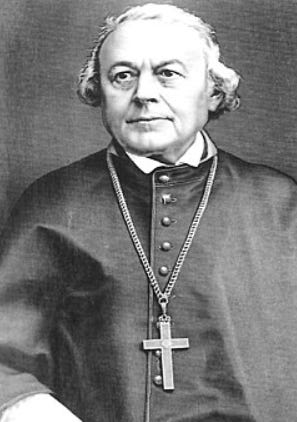
We can even bring up the historical theologians who were skeptical about Vatican 1. What about the famous German theologian Karl Josef von Hefele (+1893), who expressed doubts about the antiquity of papal infallibility while present at the Council of Vatican? He eventually came around to agreeing to the definition on condition that the infallibility is with respect to the theological definition itself and not necessarily all the reasonings that are expressed behind it. I’ll even mention Ignaz von Döllinger, who is perhaps the most famous skeptic of Pastor Aeternus and who ended up being excommunicated over it. Did either of these men join Eastern Orthodoxy since the case was obvious? One remained Catholic, and the other was excommunicated. Döllinger didn’t even join the Old Catholics, let alone any other church. He died alone and without his priesthood, all for, ironically, the “truth” of conciliarism. If the case between Catholicism and Orthodoxy were so obvious, how did it not register with men who spent the time reading the primary sources in the original languages?
(4) Obscure Historical Events?
One doesn’t need to be a specialist in biology to know what bathroom to use, but you also don’t need to be a Roman Catholic with the Peter syndrome to know that the Saints believed in the substantial ecclesiology of Vatican 1, either. Such is also obvious. But herein is the kicker - If the Saints and Councils that the Eastern Orthodox Church embraces as her own teach the Papacy, then the Orthodox Church communed with the Papacy. It matters not how much she resists it today, nor does it matter if she can find Greeks who resisted it in the past. The fact of the matter is that we have evidence of “Eastern Orthodox Saints” who, not from one corner or a few spots, but many, far and wide, and in crucial moments, taught the Papacy. Whether that means the Papacy is obviously false and therefore the 1st millennium Church is false, and therefore Eastern Orthodoxy is false, is a different question.
Here, I’m interested in history.
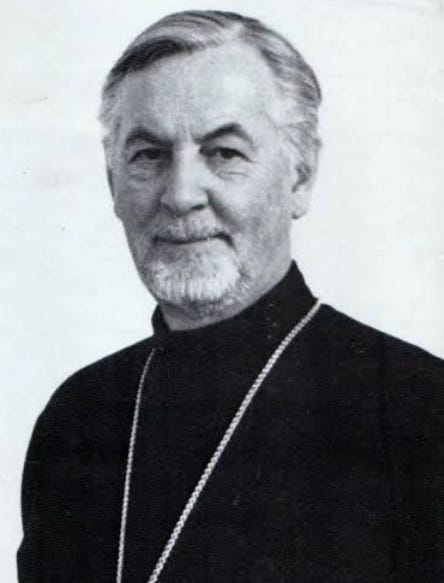
One of the most well-appreciated Orthodox theologians, Fr. Alexander Schmemann, who at one time was Professor of Church history at St. Sergius Theological Institute in Paris, states the following about the Byzantine acceptance of the Formula of Hormisdas in 518:
“The theory of the ‘power’ (potestas) of the Roman primate was openly proclaimed in Rome in the era of the ecumenical councils, and the Protestant canonist Theodor Zahn has formulated it as follows: ‘Rome is the head of the Church, without it the Church is not the Church, and only through union with Rome do the separate communities become part of the Catholic Church’. But the East did not perceive, or did not want to perceive, how this theory clearly contradicted its own doctrine. Rome always clearly followed its own policy, but the East, without ever really accepting it, until the ninth century, never once expressed its nonacceptance or rejection of it in any clear way. They always tried to conceal disagreement in diffuse and ambiguous phrases. When Catholic scholars now assert, on the basis of the Councils of Ephesus and Chalcedon, that the East recognized the primacy of Rome at that time but later rejected it, it is rather difficult to answer the charge on the basis of formal historical evidence, since one may in fact conclude from the history of those two councils that the Greek bishops admitted the special prerogatives of the Roman bishop…Even more characteristic of this eternal compromise with Rome was the signing of the formula of Pope Hormisdas by the Eastern bishops in 519, ending the thirty-year schism between Rome and Constantinople. The whole essence of the papal claims cannot be more clearly expressed than in this document, which was imposed upon the Eastern bishops… ‘The Easterners not only did not object in time to the growing mystique of papal dogmas’, wrote a Russian historian, ‘they not only silently signed the papal formulations, but they themselves, by their appeals to Rome, heedless of the juridical implications, supported the sincere illusions of the Romans that the Greeks, too, shared the Western concept of the Papacy’.” (The Historical Road of Eastern Orthodoxy, 240-41)
Could anyone imagine if the Church of the 1st millennium did with Arianism what Fr. Schememann here did with the Papacy? Namely, that Arius and his followers were tolerated for centuries and allowed to take part in the principal actions of the Church, even ecumenical councils. The failure to condemn forms a kind of consent, at least in the Patristic logic. The entire “essence” of the papal claims, i.e., Vatican 1, cannot have a more clear expression, says Schememann, than the Formula of Hormisdas. And yet, this document was signed by the Church of Constantinople twice, alongwith Emperor Justinian, and many bishops of the East, and those bishops who remained skeptical but later came around joined in communion with all who signed.

One couldn’t help but notice that the Council of Chalcedon comes up again in Schmemann’s analysis. Such an event was pivotal in the development of the Papacy in history. One need not be a Catholic or an Orthodox to notice this. The late Fr. Vilakuvelil Cherian Samuel (+1998) of the Malankara Orthodox Church, who was one of the most decorated Patristic scholars in the 20th century (having earned his Phd from Yale with a focus on the History of Christian Thought and Classical Christology), and who wrote the famous work The Council of Chalcedon Re-Examined. After reading the history of Chalcedon (pre-Conciliar and post-Conciliar documents included), he came to the following summary:
“At a time when Rome was well on its way to develop a theory of the papacy as the supreme authority over the Church as a whole, the Tome was intended by Leo to offer the final and infallible teaching of the Church on the person of Christ… Thus the role which the Tome was intended to play was a dialectical one. On the one hand, it was presented as a statement of the faith for the advantage of the Church, but on the other and more significantly it was offered as a document with Petrine authority.” (48-49)
and
“The forces which controlled the council, namely Rome on the one hand and the imperial authority in Constantinople on the other, used the council for the carrying out of their respective plans—Rome for asserting its claim of universal supremacy over the Church and the emperors for trying to bring the entire Church in the east under the jurisdiction of the see of Constantinople.” (104)
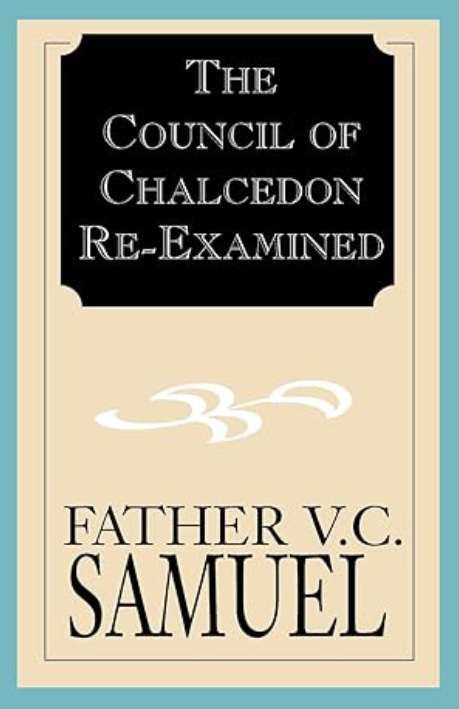
Concerning these claims to Papal authority over the East, Fr. Samuel is referring to the famous libellus Hormsidae (Formula of Hormisdas), which required the Eastern bishops to submit to the authority of Chalcedon on the grounds that the divine promise given to St. Peter by Christ resides forever in the Apostolic See.
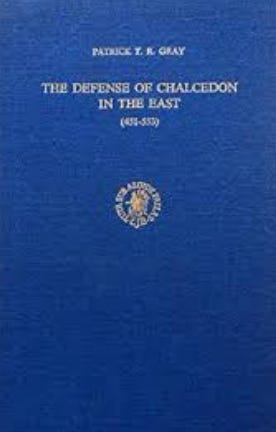
Patristics scholar Patrick T.R. Gray stated:
“Early in 519, a papal embassy, bearing the libellus… Hormisdas demanded subscription to this libellus from the patriarch of Constantinople and from all the bishops of the empire. There was complete submission to Hormisdas’ demands in Constantinople…” The Defense of Chalcedon in the East 451-553 (Leiden: E.J. Brill, 1979), 46.
In this episode, therefore, you have an instance where, as Fr. Schmemann said, the Greek East submitted to the jurisdiction of the Pope and confessed that the divine promises of Christ reside in its teaching magisterium. What more could one ask for in seeking evidence for Vatican 1 in the first millennium? And yet there was resistance. The reader should take notice that the Pope’s themselves did not ignore that there was always resistance to the authority of the Apostolic See. In the famous letter of Pope St. Agatho, he states quite plainly, after affirming the infallibility of the Roman see, that the heretics have never ceased to oppose the See of Peter:
[…] the true confession thereof for which Peter was pronounced blessed by the Lord of all things… for he received from the Redeemer of all himself, by three commendations, the duty of feeding the spiritual sheep of the Church; under whose protecting shield, this Apostolic Church of his has never turned away from the path of truth in any direction of error, whose authority, as that of the Prince of all the Apostles, the whole Catholic Church, and the Ecumenical Synods have faithfully embraced, and followed in all things; and all the venerable Fathers have embraced its Apostolic doctrine, through which they as the most approved luminaries of the Church of Christ have shone; and the holy orthodox doctors have venerated and followed it, while the heretics have pursued it with false criminations and with derogatory hatred.”
(5) Where’s the List of Ex Cathedra Decrees?!
Davis goes on:
In a recent article, I point out that Catholics affirm papal infallibility despite not being able to agree when the pope is speaking infallibly. Yet, as Mr. Ybarra demonstrates in his reply, Catholic apologists aren’t too worried by this. It doesn’t bother them that the papacy can’t actually solve debates within the Church. They’re happy to defend infallibility/supremacy as an abstraction, a theory, a logical corollary.
This is actually not what I was claiming in my article (which is still relevant). One of my claims is that one of the reasons why there isn’t a strict listing of ex cathedra decrees in the 1st millennium is that many of those decrees are simple reaffirmations of past dogmatic doctrines, such as those related to Christology. Davis wants to know where the Pope CLEARLY stepped onto the scene of a MASSIVE division in the Church and SETTLED a matter with the stroke of his pen. Such events did happen. I’ve covered the history of these things, and Fr. Schmemann and Fr. Samuel are just two of the countless theologians and historians who have also recognized this. Just regarding Chalcedon and its rehabilitation, I’ll quote one historian whose identity is hidden but whose point depends soleley on its conformity to fact:
I find it possible to envisage that if the childless Emperor Anastasius (a miaphysite and upholder of the Henotikon) had been succeeded in 518 by one of his three nephews instead of by Justin, the commander of the imperial guards, who was well-placed to seize power, eventually Chalcedon would have been repudiated in the East, replaced by some form or miaphysite Cyrillianism, and so the Greek/Latin schism might have taken place centuries earlier than it in fact did.
Let’s not be so worried about the precise number of ex cathedra decrees and ask which decrees of the Pope on faith and morals would make a difference between themselves if they were ex cathedra. If there was potentially a matter of salvation or damnation being effected by one’s acceptance or rejection of a decree wherein the pope bound the whole Church to a definition on faith and morals, then this exposition of the absence of a precise number of ex cathedra decrees would have at least some force, and we can deal with the matter in a case by case study.
(6) The Papacy Fails in Practice
Davis goes on:
Vatican I’s dogmatic constitution Pastor Aeternus presents the papacy as a “permanent benefit” to the Church. Gasser’s relatio, the official interpretation of Vatican I, calls the popes an “immobile bulwark of faith” that protects the flock from error, nourishes it with truth, and ensures it “lacks nothing.” Likewise, Pope Leo XIII’s landmark encyclical Satis Cognitum declares: “It is consequently the office of St. Peter to support the Church, and to guard it in all its strength and indestructible unity.” To say that modern popes have failed this test is putting it mildly. On the contrary: they have caused tremendous theological, liturgical, and moral disorder—even by Catholics’ own reckoning. Mr. Ybarra himself recently confessed, “I’ve never seen a worse condition in Church history.” Obviously, the infallible and supreme papacy isn’t doing its job. And if the system fails in practice, the theory is flawed. Saying “real papal infallibility has never been tried” is as incoherent as claiming Marxism “works in theory.”
Davis is thinking of the contemporary issues surrounding the papacy, and the last few papacies in particular. However, we need to hear more of what is being claimed. What heresy or error has been promulgated from the Apostolic See? That would be the standard any Church of the 1st millennium would be held to, for sure. If we can find a heresy that the Catholic Church has now subscribed to that can be furnished as certain, then there would be a case to be observed here. Otherwise, this is not substantive.
Are there pastoral catastrophes that amount to sins against prudence? I would say that is what makes up the entirety of the problem in the current-day Catholic Church. We can spend a lot of time discussing how the recent popes have handled the throne of Peter and their failures, but the 1st Vatican council does not teach the occupant of Peter’s throne is always going to be a good pastor, as neither do the Orthodox take their ecclesiological maxims (cf. Confession of Dosiethus) and believe that the Episcopate will always be attentive to the needs of the Church.
However, my specialty is researching the history of the Papacy in the 1st millennium. Whether I’m an atheist or a Catholic really doesn’t matter insofar as the objective history is looked at and compared to the ecclesiological claims of the 1st Vatican Council. One need not be a monarchist to know that the British, Mongol, Spanish, French, and Ottoman Empires were powerful monarchies. Equally, one doesn’t need to be a Christian to study the 1st millennium sources and see the plain evidence of what is going on between the Roman Pontiff and the universal Church.
If Davis were strictly interested in whether the Catholic or Orthodox Church was true by the contemporary conditions, then what business does he have in the history of the Church? If he finds Catholicism coherent on its own standing today, then that resolves the question for him. That doesn’t, however, give him the right to retell history. It also means that Eastern Orthodoxy is open to being fairly tested by whether it is coherent or not. I myself have not found it to be coherent. What then? The Orthodox Church has made worldwide news in its ecumenical ventures in Assisi, Rome, Cairo, Istanbul, and even Moscow (via the 2016 Havana declaration). There is simply no greater way to inform the Hierarchs of the Autocephalous bodies of what is going on. And yet, what is the EO Episcopate doing? One can’t hide in a decentralized Episcopate since the Episcopate itself, even diffused abroad, is supposed to retain its quality based on what she is in communion with, not what an individual hierarch or church believes and does in isolation. What of Orthodoxy’s public and open permission for the use of artificial contraception? The long-standing permission for divorce and remarriage? Similarly, Orthodox have critiqued the recent revision of the Catholic Catechism on capital punishment. What of Orthodoxy’s public testimony against capital punishment?
(7) Papal Infallibility Fails the Universality Test
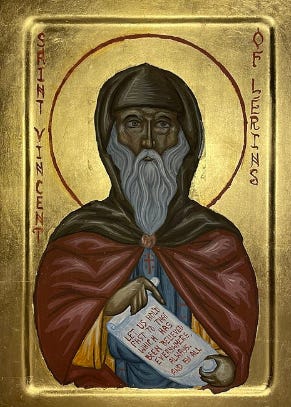
Pastor Aeternus claims papal infallibility/supremacy belongs to “the tradition received from the beginning.” It refers to papalism as the “clear witness” of Holy Scripture taught by Scripture, the constant custom of the Church, and “all the venerable fathers.” Likewise, Satis Cognitum: “Wherefore, in the decree of the Vatican Council as to the nature and authority of the primacy of the Roman Pontiff, no newly conceived opinion is set forth, but the venerable and constant belief of every age.” This echoes the Vincentian Canon, that true doctrine is what has been believed “everywhere, always, by all.” Papal infallibility fails this test spectacularly.
I would disagree with this. St. Vincent de Lerins does not mean that every single saint or Church Father in history will agree on the same faith all the time. He states that Cyprian of Carthage is among the Saints while also believing that Cyprian himself, materially, held a soul-damning heresy on rebaptism. Resistance to the papacy and/or the precise prerogatives claimed from it is expected to happen in the Church until a formal dogmatic decree. In fact, the oft-quoted statement from the 1st Vatican Council is actually a selection of the Acts of Ephesus (431), a predominantly Greek Synod that is shelved on the infallible and ecumenical level for the Eastern Orthodox. The following was said in front of all the fathers of the Council, underneath the presidency of St. Cyril of Alexandria:
Philip the presbyter and legate of the Apostolic See said: There is no doubt, and in fact it has been known in all ages, that the holy and most blessed Peter, prince (ἔξαρχος) and head of the Apostles, pillar of the faith, and foundation (θεμέλιος) of the Catholic Church, received the keys of the kingdom from our Lord Jesus Christ, the Saviour and Redeemer of the human race, and that to him was given the power of loosing and binding sins: who down even to today and forever both lives and judges in his successors. The holy and most blessed pope Cœlestine, according to due order, is his successor and holds his place, and us he sent to supply his place in this holy synod…
This is the 4th Ecumenical Council, a predominantly Greek synod. More powerful proclamations of papal authority are made at the Councils of Constantinople (681) and Nicaea (787). That would mean that at least 3 of the 7 ecumenical councils teach the basic substance of the papacy doctrine.

(8) Matthew 16 Does Not Refer to the Papacy
Davis goes on:
Consider Matthew 16:18—“You are Peter, and on this rock…” No patristic commentary on the Gospel text interprets it as establishing the papacy. Most Church Fathers see the rock as Christ, Peter’s confession, or the episcopate. A minority link the “rock” to Peter personally; none, however, connect it uniquely to Roman successors.
Davis might be surprised to know that the Catholic Catechism also interprets the “rock” as St. Peter’s confession of faith:
424 Moved by the grace of the Holy Spirit and drawn by the Father, we believe in Jesus and confess: 'You are the Christ, the Son of the living God.' On the rock of this faith confessed by St. Peter, Christ built his Church.
Davis is quite right to say that the Church Fathers see the rock as Christ or Peter’s confession. However, there aren’t that many that say the rock is the Episcopate. Of course, that doesn’t mean they didn’t actually make the connection. However, so far as I know, only St. Cyprian of Carthage came out and openly said the rock was the Episcopate. Allusions to this are made by others, such as Augustine and Leo the Great, but the issue there is that they, too, saw something uniquely stationed in Rome as related to Christ’s design for the rock and the keys. As for the keys, there are many fathers who said it refers to the episcopate and the priesthood. However, there are reasons why that implies the papacy (see here).
Moreover, many Fathers made Papal inferences from the text as well, even while reading “rock” with a faith-emphasis or a Christ-emphasis. In fact, many of the Popes who were the most adamant about the divine institution of their universal supremacy understood that Matt. 18 grounded their office while defining “rock” to be either Christ or St. Peter’s faith! One has to do a thorough research into what the Fathers say about this, and if the reader is interested, I have a presentation where I take the viewer through the 1st millennium on how most of the early Popes that no historian disputes claimed supremacy also saw that a faith or Christ emphasis on the term “rock” only enhanced the claims of the Papacy, rather than diminish them.
Lastly, even though it would not be a fair standard to only look at what the Greek fathers understood between the Petrine primacy texts of the New Testament and the Roman See, since the Latin fathers were guided by one and the same Holy Spirit, one just has to observe some of the connections made by Greek saints to know that Davis is not informed.
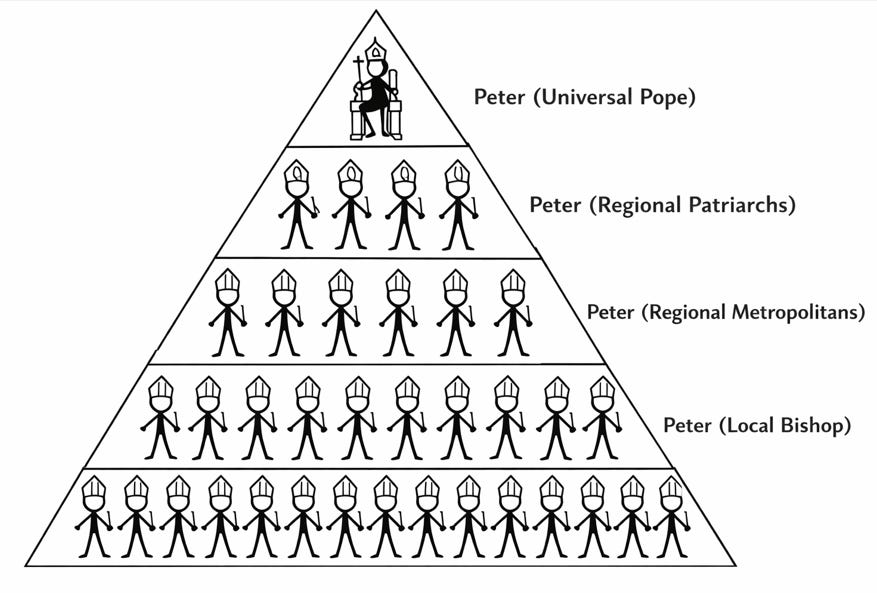
Davis and many other Orthodox believe that every bishop is a successor to Peter entails the absence of a universal Peter. However, that would be news to Pope St. Leo the Great who believed every bishop is patterened off the primacy of Peter, and yet he was adamant about the singularity of the Roman Pontiff over all other bishops. This is because he held to a Petrine relation on different levels of Church government, all reaching to an apex with Peter’s actual historical successor in Rome:
“For the cementing of our unity cannot be firm unless we be bound by the bond of love into an inseparable solidity: because as in one body we have many members, but all the members have not the same office; so we being many are one body in Christ, and all of us members one of another… And though they have a common dignity, yet they have not uniform rank; inasmuch as even among the blessed Apostles, notwithstanding the similarity of their honourable estate, there was a certain distinction of power, and while the election of them all was equal, yet it was given to one to take the lead of the rest. From which model has arisen a distinction between bishops also, and by an important ordinance it has been provided that every one should not claim everything for himself: but that there should be in each province one whose opinion should have the priority among the brethren: and again that certain whose appointment is in the greater cities should undertake a fuller responsibility, through whom the care of the universal Church should converge towards Peter’s one seat, and nothing anywhere should be separated from its Head.” (Epistle 14)
In other words, there is a local Peter who is the leader of his local church. There is the regional Peter, who is the leader (metropolitan) of the bishops. There is the Patriarchal Peter who is the leader of the metropolitans. And finally, there is the universal Peter who is the bishop of Rome, where Peter left the succession to his throne in due order. And so, one can see here that the Petrine architecture of the entire Episcopate does not devolve to an equal episcopalianism. Rather, it fits nicely with the following illustration:
Pope St. Leo believed that the apex-Peter has special prerogatives that do not reside in any of the others:
“Men resort to the see of the blessed Apostle Peter from the whole world, and require at our hands that general care for the Church which was entrusted to that see by the Lord.” (Sermon 5.2)
(9) Empty Honorifics
Davis writes:
(I’m aware that, in other contexts, some first-millennium theologians used the language of Matthew 16:18 in connection with the pope. Yet they did the same with the Roman Emperors, the Patriarch of Alexandria, and others. This was a common way of praising Christian leaders for their orthodoxy, since they thought the “rock” referred to Peter’s confession.)
Honorifics were indeed normal for ecclesiastical and political dignitaries. However, there is a clear way to distinguish between empty honorifics, partially true honorifics, and perfectly true honorifics. Some of the honorific language used of Christ, Angels, Mary, the Saints, the Apostles, the Church, Ecumenical Councils, and the Popes are really what they say they are. Other honorifics of Saints and Emperors are only partially true. An empty honorific would be akin to when the Synod of Ephesus referred to Nestorius as the “most reverend” and “most religious,” only to say just in a single sentence thereafter that he is anathematized. And so every text has a context, and each context should be scrutinized. However, to make an all-embracing exclusion of honorifics from reflecting what is real would do massive damage to the Christian faith, nay, it would destroy it.
What Davis is doing is minimizing the papal claims by relegating them to non-literal praise, i.e., Byzantine flattery. However, we know this is not true in many instances. I’ll give one example of how we know the papal claims being made can’t be reduced to what Davis claims. The below is a complaint made by Pope Hadrian I to Empress Irene concerning the title “Ecumenical Patriarch” used by the bishop of Constantinople (St. Tarasios) that was read aloud during the 7th ecumenical council, and not a single resistance to these claims was made at the Council:
We greatly wondered that in your imperial commands, directed for the Patriarch of the royal city, Tarasius, we find him there called Universal: but we know not whether this was written through ignorance or schism, or the heresy of the wicked. But henceforth we advise your most merciful and imperial majesty, that he be by no means called Universal in your writings, because it appears to be contrary to the institutions of the holy Canons and the decrees of the traditions of the holy Fathers. For he never could have ranked second, save for the authority of our holy Catholic and Apostolic Church, as is plain to all. Because if he be named Universal, above the holy Roman Church which has a prior rank, which is the head of all the Churches of God, it is certain that he shows himself as a rebel against the holy Councils, and a heretic. For, if he is Universal, he is recognized to have the Primacy even over the Church of our See, which appears ridiculous to all faithful Christians: because in the whole world the chief rank and power was given to the blessed Apostle Peter by the Redeemer of the world himself; and through the same Apostle, whose place we unworthily hold, the holy Catholic and Apostolic Roman Church holds the first rank, and the authority of power, now and for ever, so that if any one, which we believe not, has called him, or assents to his being called Universal, let him know that he is estranged from the orthodox Faith, and a rebel against our holy Catholic and Apostolic Church.
Now, it is quite clear in the mind of Hadrian that Constantinople is claiming a literal primacy over the universal Church. How can the Pope refute a literal claim with a non-literal fact? Hadrian’s argument is basically this: Constantinople cannot be universal because the See of Rome, due to its prerogatives obtained by the divine decree of Christ in blessed Peter, has been divinely fixed forever as the universal head of the church. Hadrian also says Constantinople enjoys its primacy, that of 2nd rank (via canons) because Rome allows it, but that this could never arise to a universal primacy. It is simply unintelligible to reduce this to “praise” or “flowery language.” And the meaning is obvious here and it is equally clear in other cases.
(10) What Catholics Have to Prove to Defend Vatican 1
Davis continues:
Even granting that Peter received a unique charism, Catholics would still have to prove:
• The charism of infallibility and supremacy survived Peter as an office.
• It passed only to Peter’s successors in Rome—not those in Antioch or Alexandria.
• Peter explicitly transferred the infallible/supreme charism to Linus, permanently establishing the papal office in Rome.
Moreover, they would have to prove that this was the “constant belief of every age.” Which, of course, they can’t.
Actually, all that is required is that the 1st millennium Church taught that Jesus Christ established Peter and his lineal successors would be the divinely perpetual leaders of the Church on earth until Christ returns.
That’s it.
You don’t need anything externally said about infallibility versus supremacy.
Why?
Because if it is true that the 1st millennium Church taught that the bishops of Rome would be the divinely stationed leaders of Christianity until the end of time, then that is sufficient to exclude Eastern Orthodoxy, Oriental Orthodoxy, and Protestantism. The only thing left to do in order to get this desired “proof” is to realize that the Catholic Church is the only viable hope for continuity (for she is the only one who teaches this base doctrine) and that Christ, being God, wouldn’t have established a leader of His own mystical body who would kill itself from the head down with the poison of error. This latter bit is a more philosophical necessity based on other theological presuppositions, but they are hardly debatable.
As it stands, I believe I have shown in my book that the 1st millennium Church did believe in a divinely fixed station in the Apostolic See of Rome based upon divine design with our Lord and St. Peter the Apostle, and that this, because it is etched into the DNA of the Church as an organism, is to be co-extensive with the life of the Church on earth, i.e., it will last until the end of time.
If that case is made, then the case for Catholicism is made.

I’ll give one example wherein this is shown. Many Orthodox like to bring up the trial of St. Maximus the Confessor wherein he states that if Rome goes into heresy and communes with the Monothelites, he would reject all the Patriarchs and the whole world, including Rome, even if it meant being faithful to what he knew to be true. By this, it is claimed, everything St. Maximus said about the infallibility and supremacy of the See of Peter is said to be relegated to flattery or non-literal praise. However, that doesn’t hold up to scrutiny. In a letter of one of St. Maximus’s disciples, we see that the news about Rome’s “impending” unity with the Monothelites drew great fear and concern, and an imploring of God to keep His promises to the Apostle Peter concerning his throne in Elder Rome:
“…in order that, when you have found out about the trial from these, you might all bring a common prayer to the Lord on behalf of our common mother, that is the Catholic Church, and on behalf of us your unworthy servants, for strengthening everyone and us also, persevering with you in it, according to the orthodox faith rightly preached in it by the holy fathers. For there is great fear in the whole world because this [church] endures persecution by everyone at the same time, unless He [God] offers aid by his customary grace, He who always come to aid, leaving the seed of piety at least in older Rome, confirming the promise He made to the prince of Apostles, which does not deceive us.” (Maximus the Confessor and His Companions, Page 123)
Why would anyone in the circle of St. Maximus reason this way in a non-literal fashion after hearing the news of Rome’s “impending” unity with heretics? The “seed of piety” is a reference to being faithful to the Apostolic tradition, and even here, after the false news of Rome’s capitulation, there is a reference to the promise of Matthew 16, namely, that the gates of hell shall not prevail against the Church. It would appear that Maximus’s answers under interrogation were said, but not without concern. And the proof of this is this letter.
I’ll leave a summary of St. Maximus’s understanding of the Papacy by the great Maximian scholar Lars Thunberg (Lutheran):
“In a somewhat fragmentary letter to Peter the Illustrious (from 643 or 644), which is preserved only in a Latin version, we find some explicit expressions of a very advanced theology about the position of the bishop of Rome. Maximus simply identified the see of Rome with the Catholic Church and he spoke of ‘the very holy Church of Rome, the apostolic see, which God the Word [Jesus] Himself and likewise all the holy Synods, according to the holy canons and the sacred definitions, have received, and which owns the power in all things and for all, over all the saints who are there for the whole inhabited earth, and likewise the power to unite and to dissolve….’ (Patr. Gr. 91, 144 C). Finally, in a letter written later in Rome, he made himself even more clear in the following maner: ‘...she [the Church of Rome] has the keys of the faith and of the orthodox confession; whoever approaches her humbly, to him is opened the real and unique piety, but she closes her moouth to any heretic who speaks against [divine] justice’ (Patr Gr 91, 140). This invites us to evaluate what Maximus had to say about the primacy of the pope. As Fr Garrigues has clearly shown (in an article in Istina, 1976), Maximus was convinced that Rome would never give way to the pressures of Constantinople. Once more forced to consider the possibility that in the case of Monotheletism the Romans might accept a union with the Byzantines, he answered through the paradoxical words of St. Paul, and said: ‘The Holy Spirit condemns… even the angels that would proclaim anything which is contrary to the Gospel’. (Patr Gr 90, 121). This implies that he did not want to discuss an improbable hypothesis, but would rather declare that he was prepared to die for the truth. This statement is a good starting point for a clarification of his own attitude. His personal experience of the doctrinal position of Rome confirmed his conviction that the promises of our Lord to Peter were applicable to the Church that preserved his relics. Thus, for him the communion of the Churches expressed itself as ‘a Roman communion’, a communion with the bishop of Rome. One must remember that for Maximus there existed only one alternative, represented by Imperial policy with its link between Church and State, and that alternative could not enjoy the same promises. Even sacramental signs were missing in the latter case.”(The Vision of St Maximus the Confessor: Man and the Cosmos- Lars Thunberg, Page 25-26)
(11) Emperors Called the Ecumenical Councils
Davis continues:
Pastor Aeternus asserts the pope’s primacy of jurisdiction over the whole Church, with full power to rule in faith, morals, discipline, and government. It forbids appealing from papal judgments to councils as a superior authority. Yet the Seven Ecumenical Councils were called by emperors, not popes.
That is because the ecumenical councils were state events, and not merely ecclesial. If you read the Imperial sacras opening up some of the 7 Ecumenical Councils, the Emperors explicitly state that while they don’t have authority to judge on doctrine, it is their divinely bestowed responsibility to ensure their realm is subject and obedient to the God of heaven, and so they don’t just have a helpful hand, but a binding authority to make the Bishops gather together to ensure that false doctrine is removed from the commonwealth of the Roman people. I have a 4-part mini-course going through this Imperial prerogative and how it relates to the divine vocation of the Church over its own affairs (part 1, part 2, part 3, and part 4).

.
Even the Popes who claimed to have infallible authority over the doctrinal decrees of Ecumenical Councils still recognized that the divinely appointed Emperors were possessed with the authority to gather the Ecumenical Councils, and that Popes themselves were to be obedient to that convocation. Pope St. Agatho (+680), for one example, recognized that it was the divine responsibility of Emperor Constantine IV to convene the Synod of Constantinople (681), and yet that it was equally the Emperor’s responsibility to be obedient and submissive to his authoritative letter wherein he claims the infallibility of Peter’s successors in Rome. As the great Protestant historian Philip Schaff conceded: “Agatho quotes the words of Christ to Peter… in favor of Papal infallibility, anticipating, as it were, the Vatican decision of 1870.”
Davis adds:
The popes didn’t always preside, either. Constantinople I (381) was convened by Emperor Theodosius without Pope Damasus I’s permission.
This is because the Council was not convened as an ecumenical council. It was a regional council convened by the Emperor in Constantinople, and whose title “oikumenical” (in the Acts) has the meaning of “Imperial”, i.e., good for public law. Former Professor of Canon Law at St. Vladimir’s Orthodox Seminary, Peter L’Huillier, states the following in his The Church of the Ancient Councils: The Disciplinary Work of the First Four Ecumenical Councils (p. 107):
“In the thought of the Emperor Theodosius who convoked it, as well as in its composition, the Council of Constantinople of 381 was exclusively an inter-diocesan synod of the eastern church. In order to gather together a really ecumenical council, it would have been necessary for both emperors, Gratian and Theodosius, to call it. Moreover, it was only Theodosius that the fathers of the council asked to ratify the decisions they had taken… The fathers of Constantinople in 382 were already calling the previous year’s council, 381, ecumenica, but it is nonetheless certain that they did not give to this adjective the technical and precise meaning that it acquired later on.”
In one of the most widely used works on the 7 Ecumenical Councils by Fr. Leo Donald Davis, The First Seven Ecumenical Councils (325-787), the section on the Council of 381 is given the following heading: “Unecumenical Council of Constantinople” (p. 119).
One only has to take note of how the Roman See never counted the synod of 381 as one of the great general Councils until it decided to credit it with that value due to its creed. Pope St. Gregory the Great (+604) made it clear that Rome did not receive its canons. At the Council of Chalcedon, the papal legates made it clear that Rome did not receive its canons, and would not do so. Pope St. Leo the Great made it clear to the Patriarchs and Emperor that Rome would not do so, and no one ever flexed the force of the synod of 381 against that.
However, the Byzantines did not recall this council as having been convened “without Pope Damasus I’s permission.” At the Council of Constantinople (681), the Greeks understood that both Theodosius and Damasus worked together. The famous epistle of Photius of Constantinople to Boris I of Bulgaria stated that the council of 381 was confirmed by Pope Damasus, showing the Byzantines always understood this council to have been done in cooperation between Emperor and Pope. We might be skeptical of this in light of prior facts, but the Byzantines would not have violated their own ecclesiology in thinking that a council could be ecumenical without the Apostolic See. Such was the “rule” (nomos) of ecumenical councils, according to the 7th ecumenical council. Davis’s point would render Byzantine history and its own criterion of ecumenicity false.
(12) The Meletian Schism
Davis adds concerning the Synod of 381:
Theodosius appointed Meletius of Antioch as president, despite the fact that Damasus had “deposed” Meletius some years earlier.
I would like to see the explicit documentation where Pope St. Damasus “deposed” Meletius. Secondly, that such a deposition was ordered prior to Theodosius’s assembling of the synod in 381. Unto this day, I have never seen proof that Rome condemned Meletius. What I am aware of is an express recognition of Paulinus as bishop of Antioch, a view which the Church of Alexandria shared with Rome in light of the tragic divisions that were taking place in the Antiochene church. The facts actually seem to support the view that while Meletius was not recognized as Antioch’s bishop, at least her only bishop, Meletius both claimed his unity with Rome unto the very end, and he himself signed the criterion for communion that Pope St. Damasus sent to the East in the form of a Tome. This Tome for Roman communion was upheld by the Council of Chalcedon as a monument of Apostolic communion. Surely, they did not believe Meletius was excommunicated from Rome.
In fact, the earliest commentary on how to square the papal claims with the Antiochene schism, in particular, with the election of Flavian to succeed Meletius, against the agreement to allow Paulinus to take the reins of Antioch, is Pope St. Boniface I (+422). We don’t have any other Patristic attempts to speak to the question besides this, and so it carries dominating explanatory value. We don’t need to wait until the 2nd millennium to get an explanation; we have one from a Saint, venerated by the Orthodox, just a generation after the events of Antioch’s schism. And what do we read? Catholic ecclesiology or Eastern Orthodox ecclesiology? Let the reader decide:
“The care of the universal Church, laid upon him, attends to the blessed Apostle Peter, by the Lord’s decree; which indeed, by the witness of the gospel, he knows to be founded on himself; nor can his honor ever be free from anxieties, since it is certain that the supreme authority (summam rerum) depends on his deliberation. Which things carry my mind even to the regions of the East, which by the force of our solicitude we in a manner behold…As the occasion needs it, we must prove by instances that the greatest Eastern churches, in important matters, which required greater discussion, have always consulted the Roman see, and, as often as need arose, asked its help. Athanasius and Peter, of holy memory, Bishops of the Church of Alexandria, asked the help of this see. When the Church of Antioch had been in trouble a long time, so that there was continual passing to and fro for this, first under Meletios, afterwards under Flavian, it is notorious that the Apostolic See was consulted. By whose authority, after many things done by our Church, every one knows that Flavian received the grace of communion, which he would have gone without if it were not because of letters from here acknowledging it.”(Coustant 1039; Eng. Trans. S. Herbert Scott, The Eastern Churches and the Papacy, p. 389)
(13) 4 Marks of the Church Do Not Include a 5th → “Papal”
Davis goes on:
Incidentally, it was at Constantinople I that the Four Marks of the Church—one, holy, catholic, and apostolic—were added to the Creed. Clearly, the Council Fathers did not consider any of them a synonym for “papal”!
It is widely believed by scholars today that the Creed of 381 was not constructed at the council (cf. Davis, The First Seven Ecumenical Councils (325-787), pp.120-24). But one just has to take note that the Council was not intended to be universal from the start, and we also know from the subsequent synod in 382 that they did not believe they were doing anything in opposition to the Western Church. With that fact kept in mind, this critique falls flat.
(14) The Fathers Granted Privileges to the Throne of Old Rome because it was the Royal City
Davis goes on:
The Council of Chalcedon (451) declared that “the Fathers… granted privileges to the throne of old Rome, because it was the royal city.” No mention of Christ or St. Peter.
The idea here is that if Vatican 1 is true, then the “privileges” of Rome would be from the presidency of St. Peter, not derived from the secular status of the city being the capital of the Empire. And since the Council of Chalcedon decreed that Rome’s primacy derived not from the Apostle Peter but from the political status of the city, Vatican 1 must be false.

On its face, this can appear like a good objection. However, with some probing questions and looking further into the historical data, this objection melts down like a wax inside the fires of Mordor. This canon actually has next to nothing to do with Rome’s universal primacy, something no one denied came from Apostolic designation.
These are the questions that need to be asked:
(1) Who are these “Fathers”?
(2) What are these “privileges”?
(3) When did the “Fathers” give them to Rome?
Do we hear of anything like this at the previous Ecumenical Councils? None of the prior councils even speak about granting privileges to Rome. Even at the Council of Constantinople (381), the 3rd canon simply assumes that Rome had occupied the 1st place in the primatial hierarchy of sees: “As for the bishop of Constantinople, let him have the prerogatives of honor after the bishop of Rome, seeing that this city is the new Rome.” Was it then at the Council of Nicaea (325) that Rome was given privileges? We don’t have any canon on the record indicating such. The closest thing we have comes in the 6th canon of Nicaea, which is slightly different in the Latin and Greek editions.
Greek: Let the ancient customs be maintained in Egypt, in Libya, and in the Pentapolis so that the bishop of Alexandria has authority over all these territories, since for the bishop of Rome there is a similar practice and the same thing concerning Antioch; and in other provinces, let the prerogatives of the churches (of the capitals) be safeguarded
Latin: The church of Rome has always had primacy. Egypt is therefore also to enjoy the right that the bishop of Alexandria has authority over everything, since this is the custom for the Roman bishop also. Likewise, both the one appointed in Antioch; and in the other provinces the churches of the larger cities, are to enjoy primacy.
In the Greek version, there is a reference to the “ancient customs” of Alexandria and Antioch, and thus something pre-dating even the Council of Nicaea itself. In the Latin version, which was read out loud during the 16th session of Chalcedon (451), says that the Roman church has “always” had primacy.
Always? Ancient?
So even as far back as 325, the privileges of Rome, Alexandria, and Antioch are either said to be ancient or that they have always enjoyed these privileges. What could that mean? Is there any synods prior to 325 that were convened in order to rank the primatial Churches? We have nothing in the record. And yet, Chalcedon states that the Fathers granted privileges to Rome because it was the royal city.
I ask again— who are these “Fathers” and when/where did they give Rome these privileges, and what are these privileges?
If, as the Latin text of canon 6 states, Rome has “always” had primacy, then that means it had primacy since the start of its founding… which goes back to Apostolic times. If the primacy of Rome arose at its beginning, then that means the Apostle Peter’s ministry intersects with the primacy of Rome. As it turns out, a contemporary of the Council of Chalcedon, Pope St. Leo the Great, who was considered the champion of the Council (e.g., his Tome to St. Flavian) tells us that Sts. Peter and Paul were providentially led to the Imperial capital in order that from the chief city of the world, the chief Apostles might evangelize the nations:
But, besides that reverence which today’s festival has gained from all the world, it is to be honoured with special and peculiar exultation in our city, that there may be a predominance of gladness on the day of their martyrdom in the place where the chief of the Apostles met their glorious end. For these are the men, through whom the light of Christ’s gospel shone on you, O Rome, and through whom you, who was the teacher of error, was made the disciple of Truth. These are your holy Fathers and true shepherds, who gave you claims to be numbered among the heavenly kingdoms… These are they who promoted you to such glory, that being made a holy nation, a chosen people, a priestly and royal state, and the head of the world through the blessed Peter’s holy See you attained a wider sway by the worship of God than by earthly government… For the Divinely-planned work particularly required that many kingdoms should be leagued together under one empire, so that the preaching of the world might quickly reach to all people, when they were held beneath the rule of one state…. To this city then, most blessed Apostle Peter, you did not fear to come… you had already founded the Church at Antioch, where first the dignity of the Christian name arose… and, without doubt as to the success of the work, with full knowledge of the short span of your life carried the trophy of Christ’s cross into the citadel of Rome, whither by the Divine fore-ordaining there accompanied you the honour of great power and the glory of much suffering.” (Sermon 82)
Therefore, what Chalcedon (451) meant by “Fathers” has to be a reference to Peter, Paul, the Apostles, and all the early Church ministers who were associated in the establishment of the Roman Church and its relationship to the other churches. The very same has to be said of the “ancient customs” (cf. canon 6 of Nicaea) enjoyed by Alexandria and Antioch. St. Leo the Great likewise traces this back to Apostolic times:
“The rights of provincial primates may not be overthrown nor metropolitan bishops be defrauded of privileges based on antiquity. The See of Alexandria may not lose any of that dignity which it merited through S. Mark, the evangelist and disciple of the blessed Peter… The church of Antioch too, in which first at the preaching of the blessed Apostle Peter the Christian name arose, must continue in the position assigned it by the Fathers, and being set in the third place must never be lowered therefrom.” (Letter 106)
So we see here that the Apostolic mission of St. Peter and his disciple St. Mark are the foundational causes of the respective “privileges” of Alexandria and Antioch. And notice Leo uses the term “Fathers” and their assigning 3rd place to Antioch, and, it can be safely assumed, he would have understood the same Fathers to have assigned 2nd place to Alexandria. That is extremely significant because the “Fathers” here is a reference to the 318 bishops who gathered at Nicaea (if you read the rest of letter 106, that becomes clear). The Fathers at Nicaea didn’t really “grant” these privileges to Alexandria and Antioch, as Leo just said that the dignities of those churches come from Sts. Peter and Mark, and the very 6th canon of Nicaea, defines the “privileges” as “ancient customs”, thereby making it clear that they were not newly established but rather canonically codified.
Most importantly, the “privileges” spoken about are the “rights of provincial primates” and “metropolitan bishops”. In other words, the privileges are referringt o the regional primacy of the great city-churches. It is, therefore, to no surprise that when the 28th canon of Chalcedon uses the “privileges” given to old Rome as the impetus to enhance the privileges of Constantinople, it specifies that Constantinople’s elevation would involve regional patriarchal rights over Pontus, Asia, and Thrace.
We can now revisit the 3 questions:
(1) Who are these “Fathers”? Apostles, Early Missionaries, Early Bishops, Nicaea (325)
(2) What are these “privileges”? Overseeing episcopal elections in wider territories over multiple provinces
(3) When did the “Fathers” give them to Rome? They were there from the start or close to it under Apostolic supervision (Peter, Mark, etc. etc.)
In other words, the privileges given to Rome by the “Fathers” (a mixture of Apostolic merit together with canonical codification) is not speaking of the universal Petrine authority over all the churches but rather the regional Patriarchal oversight of Rome in the West. As it turns out, then, the 28th canon has nothing to do with supporting or diminishing the universal jurisdiction of the Roman Pontiff over the whole Church, but rather is speaking of a very specific pastoral role of a city-Church vis-à-vis neighboring churches in the election of metropolitan bishops and bishops. Alexandria had oversight of episcopal elections in an extended area in Egypt. Antioch, likewise, had oversight of episcopal elections in an extended area in Syria. The same is true for Rome in Italy. This is not Papal prerogatives, i.e., universal jurisdiction, but rather a sub-layer of primacy of which Rome enjoyed first place because it was the capital of the Empire.
Therefore, Davis’s intended critique of the papacy via canon 28 has evaporated.
(15) The Council of Constantinople (553) Rejects the Papacy
Davis goes on:
At Constantinople II (553), the emperor and bishops compelled Pope Vigilius to attend against his will, overriding his support for the heretical Three Chapters. The Council Fathers insisted that such disputes require fraternal debate: “The truth cannot be made clear in any other way when there are debates about questions of faith,” they warned the pope, “since everyone requires the assistance of his neighbor.”
The history surrounding the Three Chapters controversy is very thorny and complex. This short summation of Davis ignores so much of what went on, and it would require an entire book to detail the history of the events leading up to and surrounding. However, we should be able to just give a short zinger answer to this, and if Davis is interested in a longer conversation, I’d be happy to do so.
Pope Vigilius did not listen to that advice. Contrary to what gets claimed by Orthodox apologists, Vigilius did not “submit” himself to the Council. Rather, he ended up writing a 2nd constitution wherein he took over the decrees of the Council and condemned the Three Chapters on his own authority, claiming he himself had never wavered in the Church’s christological teaching, despite being misled about the facts of the Three Chapters. The Rev. Dr. Richard Price summarizes in his The Acts of the Council of Constantinople of 553 (p. 57):
“When he capitulated to imperial pressue and came to sign his Second Letter to Eutychius and the second Constitutum, he in no way lessed his claims. He confirmed the decrees of the council, but he did not confirm its authority; indeed he made no mention of it at all. Instead he took over its decrees and issued them in his own name. Again, it is his own voice that is presented as definitive.”
In fact, in the final edition of the Acts of this council, the earlier “excommunication” of Vigilius in Session 7 was expunged from the Acts, and the Pope’s 2nd Constitutum was actually inserted in its place (ex post facto) to simulate complete cooperation between the Council and the Pope. In other words, the official syntax of the Council doesn’t have any sense of a Pope vs. Council standoff. Moreover, the 2nd Constitutum includes the Pope’s own petrine claim to universal authority. Subsequent councils and fathers look back upon the affair as one in which Vigilius was totally free from error (cf. the Council of 681’s recounting of the events). Not a single Byzantine brought forth the name of Vigilius in resistance to papal claims or to rebut the claim to infallibility during the Greek-Latin schism.
For example, see how Photius of Constantinople recounts Vigilius in his Mystagogy of the Holy Spirit written a little over 3 centuries after the 5th ecumenical council, mistakenly believing that Vigilius rejected the Filioque:
“You should consider the equally renowned Vigilius, equal in throne and rank of glory with those other men [previous Saintly Pope], who assisted at the Fifth Synod which is also adorned with holy and ecumenical decrees. Like an unerring rule, this man conformed himself to its true dogmas. He voiced agreement in other matters and with equal zeal matching those Fathers before him and of his own time, proclaiming that the All-Holy and Consubstantial Spirit proceeds from the Father, also saying that if anyone introduced any definition other than the unanimous and common faith of the pious, then he should be delivered to the same bonds of anathema.” (Chapter 82); brackets are mine, emphasis mine
In his famous letter to Boris I of Bulgaria, Photius recounts the events without any notice of the Pope’s supposed “error” or a problem with his being absent, even designating him one of the “leaders” of the Council:
“The Fifth holy Ecumenical Synod was held in Constantinople itself and was attended by 165 prelates. Its distinguished leaders were Menas at first and then Eutychios, who succeeded the former as patriarch of the imperial city. Vigilius, the bishop of Rome, was present in the city but not at the synod. Even if he was reluctant to attend the synod, he still confirmed the common faith of the fathers in a small book.” (p. 47)
(16) Anathema to Honorius, Pope of Old Rome!
Davis:
Constantinople III (680) anathematized Pope Honorius and expelled him from the Church.
To be more accurate, Pope St. Leo II confirmed the judgment of the anathema of his predecessor Honorius. Anyone who reads the papal history on this event will understand that the papal claims were not hindered by this but only further demonstrated. For example, let’s read the very decree of Pope St. Leo II which anathematized Honorius. Does one sense any backtracking of the papal claims?
“My predecessor, Pope Agatho of Apostolic memory, together with his honorable Synod, preached this norm of the right apostolic tradition. This he sent by letter to your piety by his own legates, demonstrating it and confirming it by the usage of the holy and approved teachers of the Church. And now the holy and great Synod, celebrated by the favor of God and your own has accepted it and embraced it in all things with us, as recognizing in it the pure teaching of the blessed Peter, the prince of the Apostles, and discovering in it the marks of sound piety. Therefore, the holy and universal sixth synod, which by the will of God your clemency summoned and presided, has followed in all things the teaching of the Apostles and approved Fathers. And because, as we have said, it has perfectly preached the definition of the true faith which the Apostolic See of blessed Peter the Apostle (whose office we unworthily hold) also reverently receives, therefore we, and by our ministry this reverend Apostolic See, wholly and with full agreement do consent to the definitions made by it, and by the authority of blessed Peter do confirm them, even as we have received firmness from the Lord Himself upon the firm rock which is Christ…And in like manner we anathematize the inventors of the new error, that is, Theodore, Bishop of Pharan, Sergius, Pyrrhus, Paul and Peter, betrayers rather than leaders of the Church of Constantinople, and also Honorius, who did not attempt to sanctify this Apostolic Church with the teaching of Apostolic tradition, but by profane treachery permitted its purity to be polluted.” (Source)
Pope St. Leo II surely did not see any hindrance to the power and authority of the Apostolic See by the heresy of Honorius. In fact, Pope Hadrian II made this clear at the Council of Constantinople (869):
“For even though Honorius was anathematized after his death by the easterners, it should be known that he had been accused of heresy, which is the only offence where inferiors have the right to resist the initiatives of their superiors or are free to reject their false opinions, although EVEN IN THIS CASE no patriarch or other bishop has the right of passing any judgement on him unless the consent of the pontiff of the same first see has authorized it.” (Price, 314)
In the midst of the 7th session of Constantinople (869), the Pope and the bishops rehearse the inability of anyone to judge the Roman Pontiff, and they bring up the Honorius affair as the pro-Photian bishops of Constantinople could easily use him against the papal claims (they did not bring up Vigilius, so far as I know). Hadrian II anticipates this and says that while a sitting Pope may err, it would have to be a successor Pope who consents to the anathema of a Pope.
(17) No One Can Add to the Creed!
Davis:
Pope St. Leo III (9th c.) rejected attempts to add the filioque to the Nicene Creed because the creed had been formulated by two Ecumenical Councils. Echoing Constantinople II, he pointed out that the Council Fathers had “acted upon divine illumination rather than by human wisdom,” Leo declared. “Far be it from me to count myself their equal.”
It is true that Pope St. Leo III chose to submit himself to the rules already set by previous Councils. It is the Pope’s choice to do so. However, that does not mean he is absolutely forbidden from changing the creed if it means to help the faith. This is the very same circumstance surrounding the enlargement of the creed from the 325-version (Nicaea) and the 381-version (Constantinople). Arguments in favor of this were already seen in Western synods in the 8th century (e.g., St. Paulinus II of Aquileia).
Pope St. Leo III also thought that anyone who disagreed with the doctrine of the Filioque could not be a Christian since it would be to deny an essential dogma of the Trinity. Aside from this, Leo III also manifestly defended the dictum that the Roman Pontiff could not be judged by any inferior, ecclesiastical or secular. This is why Fr. Vladimir Guetee (1816-1892), the famous French historian and Catholic priest who converted to Eastern Orthodoxy, in his La Papauté Schismatique (The Schismatic Papacy), accuses Leo III of manifesting the full-blown “error” of papal supremacy:
“Charlemagne having come to Rome (800) as a patrician of that city, assembled a council to judge the Pope. But Leo was sure beforehand that he would prevail. He had received Charlemagne in triumph, and the powerful king was not ungrateful for the attentions of the pontiff. The members of the Council accordingly declared with one voice: ‘We dare not judge the Apostolic See, which is the head of all the churches; such is ancient custom!’.... According to this new code of a new Papacy, the Apostolic See, which could judge all, could be judged of none. Rome neglected no chance to establish this fundamental principle of her power, of which the inevitable consequence is Papal infallibility and even impeccability… Thus was the Roman empire of the West reestablished. Rome, who had always looked with jealousy upon the removal of the seat of government to Constantinople, was in transports of joy; the Papacy, pandering to her secret lusts, was now invested with power such as she had never before possessed. The idea of Adrian was achieved by his successor [Leo III]. The modern Papacy, a mixed institution half political and half religious, was established; a new era was beginning for the Church of Jesus Christ– an era of intrigues and struggles, deposit and revolutions, innovations and scandals.” (p. 269)
Note where Guettee says that in Leo III we see the achievement of the “idea” of Pope Adrian I. Below is what Guettee believes about Adrian’s idea:
“[Pope] Adrian [I] is the true creator of the modern Papacy. Not finding in the traditions of the Church the documents necessary to support his ambitious views, he rested them upon apocryphal documents written to suit the occasion, and to legalize all future usurpations of the Roman see. Adrian knew that the Decretals contained in the code of Ingelramm were false…” (p. 261)
And so even if it is the case that Pope St. Leo III thought the creed was untouchable, the evidence of what he believed about the Filioque and the supremacy of the Pope is equally heretical by Eastern Orthodox standards. In fact, it can be well-argued that if the Filioque is theologically true, Eastern Orthodoxy is false. Leo III clearly upheld it as a dogma.
(18) CONCLUSION
Davis tries to simplify the debate between Catholics and Orthodox by what he deems “obvious.” However, as can be shown in this article, the Orthodox Church itself is far from being obviously correct. And while there are difficulties with the current-day Catholic Church, the debate about which side is more faithful to the tradition, fathers, doctors, saints, and councils of the 1st millennium is far from easy to resolve. The data leaves sufficient support for Catholicism such that anyone defending the papal claims from history has a strong case, even if it doesn’t compel one to be convinced. And to say otherwise is to be uninformed.
What Davis says might be satisfactory for those who have no time to dig into the material, but for those who have been spending a lifetime in the sources, appealing to what appears obvious from a surface-level treatment of history (and an erroneous treatment, at that!), simply won’t satisfy. What we find is significant, noteworthy, and clear evidence in support of the basic substance of Vatican 1 in sources that should be perfectly devoid of it if Eastern Orthodoxy were true. At the very least, the Catholic has a place in arguing for the presence of the papacy in the early centuries, even if we can concede that the historical data is not all one-sided.
On Vatican I’s firm decree that “in the apostolic primacy which the Roman Pontiff as the successor of Peter the chief of the Apostles holds in relation to the whole Church, is included the highest power of magisterium,” the Anglican historian Trevor Jalland admits that with an objective investigation, it can be conceded, even against what the majority of Anglican historians conceded, that such a primacy existed in the primitive Church:
“If the argument of our third lecture holds good, there is more evidence for the general acceptance of such a primacy in the primitive Church than has been generally recognized, at least by the majority of Anglican historians, and even if it is true that from time to time in the post-Nicene period it had to face a serious challenge, yet this challenge for the most part may be seen to coincide with those periods in which some form of Caesaropapism was predominant.” (The Church and the Papacy, 532-33)
The basic rule of papal supremacy, says Jalland, can be firmly seen in 5th century Rome:
“The assertion with which the third chapter concludes, that the Roman Pontiff is the supreme judge of all Christians in ecclesiastical causes, and that his decision is not open to reconsideration even by an oecumenical council, simply formulates afresh a claim on the part of the Roman see made in principle at least as early as the fifth century.” (ibid., 30)
The Jesuit historian Fr. Klaus Schatz, S.J. made an apt observation about the papacy in history. Ironically, people like to quote Schatz against Vatican 1 because he argues that certain structures essential to it were absent in the pre-Nicene era (one wonders why it is not mentioned that he indicates the very same absence for the Monoepiscopacy in the early years of the Church), and yet in his final analysis he admits that while there were varying senses of primacy in the 1st millennium (heck, there are some differences even today between Catholic theologians), the precise ecclesiology of Vatican 1 has a “trace” in the 1st millennium and that as time moved forward, the factors that sought to obstruct the authority of Rome over the universal church were put down, making way for the growth of the papacy:
“First of all, historically speaking, the Roman primacy of jurisdiction and teaching as dogmatically sanctioned at Vatican I developed historically as a result of a great many factors. The recognition of the Roman church as the center of communion existed by the fourth or fifth century in the West… To that extent, one must say, speaking historically, that Vatican I proposed and gave the stamp of approval to one particular line of tradition, one tendency that can be traced back to late antiquity. To identify that tendency specifically with Pseudo-Isidore, the Gregorian period, or some later point is to oversimply the course of history. The origins of papal primacy of jurisdiction can no more be assigned to a specific and fixed point in time than can ‘papal infallibility.’ Every new appearance is anchored by a hundred rootlets to earlier motifs, ideas, formulas, and laws… In general, we must be struck by the fact that the historical factors promoting papal primacy endured over time while the factors obstructing it, always present as well… only served as temporal hurdles, and sometimes contributed in the long run to strengthen the cause of primacy.” (p. 176-77)
These arguments are so worn I'm surprised people still make them. There are things to say in Orthodoxy's favor but these aren't really it. I hope the man has found whatever he was looking for in Orthodoxy but I'm glad Erick has undertaken to refute them, since I just don't have the patience for it.
My own hopefully value-add thoughts and emphasis:
#1 Double-standards are easy to fall into, regardless of the topic or sides. EO does put all its eggs in one basket, namely the episcopate as a whole or ecumenical councils, as any Protestant could point out. To reject this traditional EO ecclesiology is merely to fall into Protestant ecclesiology.
#2 Again, holding EO to its own legit standard/methodology of florilegia and thus exposing the double-standard and the ignorance of Ybarra's work.
#3 Appeals to perspicuity or "obviousness" is just lazy and sloppy special pleading. (And yet he accuses Catholics a lazy "quote-mining"?) Putting forth the stories of famous heavy-weight intellectual converts is a good counter.
#4 Hostile non-Catholic witnesses to the Catholic interpretation of historical events are the most powerful and effective witnesses, at least at diffusing the ad hominem attacks of bias and "Peter syndrome." Non-Catholics try this tactic too in appealing to Chieti & Ravenna docs and a few Catholic scholars who generally are speaking outside their expertise/competence, but we have answers to that, and I haven't seen those answers engaged. Instead of hand-waving away the evidence in the name of flattery/honorifics or perspicuity, why can't EO engage each piece of evidence (ecumenical council or saint) one at a time on its own terms? Ybarra does this with the most difficult evidence challenging the Catholic papal claims. Again, another double-standard in approaching the evidence.
#5&6 As Lofton has pointed out, no one thinks the Catholic Church was unable to clarify and settle the matter of the Marian dogmas. They are so clear that they are obvious and frequent targets for non-Catholic attacks. The speed and decisiveness of the papacy (or Church generally!) to clarify doctrinal confusion at a particular time and place is something that the Holy Spirit apparently allows a lot of leeway to. If EO ecclesiology allows for long periods of time for the Holy Spirit to finally rescue the Church generally through councils (directed and approved by Rome historically), it should apply the same standard with regard to rescues through the papacy. When EO adopt Protestant talking points, they always undermine EO too.
#7 Doesn't get more universal than ecumenical councils: https://youtu.be/ScgWXKRTRjA
#8 No early Church father excluded Peter from being the Rock: https://youtu.be/TS6NLhfGK6Y
There is early, consistent, & universal/Eastern testimony linking Mt 16:18 to Rome and papal prerogatives: https://youtu.be/gVV9XyMPSIY
#9 When patristic, saintly, and Eastern testimony appeal to Scripture like Mt 16, Lk 22, & Jn 21 and acknowledge the specific Roman powers to excommunicate, approve councils as ecumenical, and settle doctrinal matters, one has to take all that seriously rather than dismiss as mere Byzantine flattery. And one has to ask: are the popes flattering themselves when they speak of their own supreme power and authority? Hadrian isn't quibbling over titles but the real power and authority that such titles manifest/communicate.
#10 Yes, shocking as it might be to some, proving papal infallibility or indefectibility is not essential to proving a minimal facts papacy. Papal infallibility and indefectibility are more of a necessary consequence of divinely instituted papal leadership. Not sure there's a significant distinction between leadership and supremacy though....
#11 Doesn't matter who calls the council. What matters is who decides which councils are binding or not on the whole Church. Ybarra demolishes this objection in this video: https://www.youtube.com/watch?v=-ZAWIOpXxSk
#12 lol, talk about "obscure historical events" related to the details of the Meletian schism! Nicely handled, asking for the clear historical evidence and using the earliest interpretation of such events.
#13 The Nicene Creed was formulated to address specific heresies, not to be comprehensive. The lack of direct and explicit mention of the papacy cuts both ways. One could easily say its absence speaks to it already being agreed upon, especially in light of other testimony. Implicitly though, a Church that is "one, holy, and catholic" requires or implies a mechanism to achieve all 3 of those marks simultaneously. The Creed mentions nothing specific about councils or bishops or Church governance either, which is why some Protestants feel free to affirm it. If one appeals to the implicit context that the Creed was created by an ecumenical council, besides the scholarly doubt about that, one could also appeal to the contextual fact that Rome eventually approved it.
# 14 Just too much contextual information arguing against Davis' interpretation of Chalcedon, which was dominated by Pope Leo: https://youtu.be/ScgWXKRTRjA?si=LWNIFH8CDT_L_U9P&t=158
#15&16 Concessions are made when appropriate, mischaracterizations corrected, and the difficulties are confronted and explained satisfactorily and coherently. Every side has difficulties to explain.
#17 The fact that the creed was already revised once is prima facie evidence that creeds, including and especially the Nicene one, can indeed be changed to further clarify the faith. Seems like a dumb objection in context.